Wednesday, November 26, 2008

Vatican: "Unspeakable" Armenian Suffering

ANSA English Media Service

November 24, 2008 Monday 1:09 PM CET
Italy

(ANSA) - Vatican City, November 24 - Pope Benedict XVI on Monday spoke
of the "unspeakable suffering" of the Armenian people but did not
use the word "genocide", a term rejected by Turkey but widely used by
historians. Meeting with the religious head of the Armenian diaspora
in Lebanon, Aram I, the pope said the Armenians had experienced a
"period of unspeakable suffering" during the last century. In Aram's
previous visit to Rome in 1997, Pope John Paul II spoke openly of the
Armenian "genocide". On Monday Aram urged all states to recognise
"all genocides, including that of the Armenians". The use of the
word is strongly contested by Turkey and is one of the stumbling
blocks to Turkey's bid to join the European Union. France passed a
bill two years ago making it an offence to deny that Armenia suffered
"genocide" at the hands of the Turks, but the bill was subsequently
buried in the French Senate after furious Turkish reactions. Armenia
says Ottoman Turks killed 1.5 million people systematically in 1915 -
a claim strongly denied by Turkey.

Tuesday, November 11, 2008

TURKISH JUDGE PUBLICLY CRITICIZES DENIAL OF ARMENIAN GENOCIDE

Scores of highly sympathetic articles about the Armenian Genocide have appeared in the Turkish press in recent months, despite Turkey’s repressive laws that make it a crime to discuss this taboo subject.

One such article appeared in the October 30 issue of the liberal newspaper Taraf. It was authored by a very unlikely writer -- Judge Faruk Ozsu from Odemish, near Izmir. This is probably the first time that a sitting Turkish judge publicly expresses such daring thoughts in violation of article 301 of the penal code. He criticizes and mocks the Turkish government’s distorted version of the Armenian Genocide that has been fed to the public for decades.

Judge Ozsu asserts that Turkish denialists contradict themselves by first denying that anything happened in 1915 and then stating that those killings were committed "in defense of the homeland."

Referring to the three Turks, recently sentenced by a Swiss Court for denying the Armenian Genocide, Judge Ozsu writes that contrary to widespread Turkish misrepresentation Switzerland did not restrict freedom of expression, but in fact upheld human dignity. Moreover, he ridicules all those who claim that "from the point of view of freedom of expression, Turkey is more advanced that Switzerland" -- a statement he characterizes as a hilarious comedy! In his judgment, those toeing the official Turkish line on the Armenian Genocide are "blind patriots" who accuse of treason anyone expressing the slightest human sensibility on this subject.

Judge Ozsu describes himself as "a simple man who has not lost his conscience, despite his nationalistic education." He explains that since Switzerland has acknowledged 1915 as genocide, everyone in that country is obliged to obey the law of the land. He goes on to quote Elie Wiesel as saying that the denial of genocide is the continuation of genocide. That is why, the Judge writes, "it is mandatory that denial be deemed a crime."

The Honorable Judge further contends that the denial of genocide is unrelated to the scholarly investigation of facts. He condemns French historian Gilles Weinstein and Turkish Professor Baskin Oran for claiming that "there are no documents proving that the killings were committed according to a government plan, therefore it is not possible to qualify these events as genocide." In the Judge’s view, those making such comments are simply trying to save their necks from "the claws of article 301."

In a direct reference to Dogu Perincek who was convicted by the Swiss Supreme Court last year for denying the Armenian Genocide, Judge Ozsu made the following observations:

- "Perincek’s association bears the name of Talaat Pasha who is viewed as a ‘Turkish Hitler.’"

- "Those who declare that the Armenian Genocide is ‘an imperialist lie,’ show no respect for the deaths of hundreds of thousands of people, but exclaim: ‘Long live the Ittihadists; we were right [to kill the Armenians] and we can do the same thing now,’ then the only person who will pay attention to them is a Swiss judge."

- "Disputing the genocide, making racist statements, and praising the commission of a crime is now a legal issue in Switzerland, and not an attempt to seek the truth through scientific inquiry."

To be sure, the Judge takes a dim view of his country’s educational system which keeps Turks in a state of ignorance about 1915, while people outside Turkey, who have not had a "Turkish education," view things differently. Explaining that the term genocide was coined by a Polish-Jewish attorney named Raphael Lemkin in 1933, in the aftermath of the Armenian Genocide, and before the Holocaust had taken place, which means that "the Genocide Convention signed by Turkey was inspired by the Armenian Genocide."

The Judge is particularly irate at the Turkish government’s insensitivity toward the mass killings of Armenians. He states: "The official Turkish position is that during the war Armenians from certain regions were temporarily sent to the Southern region and during that period about 300,000 Armenians perished due to different circumstances. Any Turk who has not been through ‘Turkish education’ and has kept his conscience intact, upon hearing the 300,000 figure, would say, ‘Oh My God’ and will start thinking about that number."

Consequently, the Judge suggests that the first thing Turks should do is "to state that we feel terrible regarding these events…. Those who died at that time were not our enemies, but our citizens. Some of those who died were children. No one can speak of children as enemies."

Judge Ozsu concludes: "The Swiss Court’s verdict is neither against democracy nor freedom of expression. Switzerland simply does not allow the events leading to the deaths of hundreds of thousands of people to be characterized by racist and insensitive words that insult people’s dignity. Switzerland simply does not allow that the victim be victimized for a second time!"

Given the Turkish government’s well-established record of punishing all factual references to the Armenian Genocide, we fear that this righteous judge may be dismissed from his job and even get imprisoned for simply telling the truth!

By Harut Sassounian, Publisher, The California Courier

Tuesday, November 04, 2008

NEW DOCUMENT ON THE TURKISH ANTI-ARMENIAN POLICY IN 1934

armradio.am

The US Department of State recently discovered a document proving
that over 1934 the Turkish government continued its genocide policy
towards the Armenian population.

In a letter sent from the US Embassy in Ankara, Ambassador Robert
P. Skinner summarizes the way in which the Turkish government
constrained the remaining Armenians living in Anatolia, to give up
their properties before being exiled from their hearths, independent
correspondent Jean Eckian informed.

Robert P. Skinner indicates that: "It is probable, that their expulsion
is quite simply a step moreover of the Turkish government in its
policy stated to make of Anatolia a space purely inhabited by Turks."

Moreover, the dating of this letter shows that the crime committed
against the Armenians is not something which can simply be relegated
to the Ottoman time.

The full text of Ambassador Robert P. Skinner's letter, dated March 2,
1934, is presented below:

"I have the honor to bring to the Department's attention such details
as have reached the Embassy from several sources concerning the recent
deportations of Armenians from the interior of Anatolia to Istanbul.

The deportees began to arrive at Istanbul some six weeks ago and
they are quartered by the Armenian Church and its auxiliary relief
organizations in Churches, school houses and abandoned buildings in
the villages of Oteköy and Yeniköy. About 600 Armenians are now being
taken care of. They are from various towns and villages of Anatolia.

It is assumed by most of the deportees that their expulsion from
their homes in Anatolia is a part of the Government's program of
making Anatolia a pure Turkish district.

They relate that the Turkish police, in towns and villages where
Armenians lived, attempted to instigate local Moslem people to drive
the Armenians away. These efforts failed completely. The authorities
then brought in Turks from Rumeli and intimated to them that they
could take over the Armenian possessions. This new element, however,
instead of taking a hostile attitude toward the Armenians became
most congenial with them. These two means failing, the Armenians
were told that they had to leave at once for Istanbul. They sold
their possessions receiving for them ruinous price. I have been told
that cattle worth several hundred liras a head had been sold for as
little as five liras a head. My informant stated that the Armenians
were permitted to sell their property in order that no one of them
could say that they were forced to abandon it. However, the sale
under these conditions amounted to a practical abandonment.

The Armenians were obliged to walk from their villages to the
railways and then they were shipped by train to Istanbul. Local relief
organizations are doing their best to attempt to find employment is
found. However, the size of the task is staggering. Local sympathetic
people have been canvassed to contribute money for their relief.

The real reasons for the deportations are unknown. A few Armenians
believe that it is due to their superior business methods which
arouses jealousy among certain Turkish elements. The Armenians are
know for their energy and thoroughness in business and many of them
believe that they suffering now for these qualities. It is likely,
though, that their removal is simply one step in the government's
avowed policy of making Anatolia purely Turkish."

Thursday, October 30, 2008

Corpses of Armenian children left in gutter - Photo Collection of Armin Wegner

Photo Collection of Armin T. Wegner
Caption: "Abandoned and murdered small children of the (Armenian) deportees, "according to the photographer, 1915-1916. Three are dead including stripped boy in gutter. Location: Ottoman empire, region Syria.

--------------------------------------------------------------------------------------------------

What are your thoughts when you look at this picture?

When I see that man walking away in a suit, shows how indifferent a human being can be to the sufferings of others.
Children are dying and some already dead he walks away.

These children parents are murdered in the hands of Turks because they were Armenians. Now they are orphans.

Indifference is one of the greatest sins.

The Bible tells us:

James 2:13 "For judgment will be merciless to one who has shown no mercy"

MEMORIES OF EYEWITNESS-SURVIVORS OF THE ARMENIAN GENOCIDE

As a result of the Genocide of the Armenians in 1915, the deportation from Cilicia (1921) and the disaster of Izmir (1922), more than 1.5 million Western Armenians were exterminated in the hands of Turks, while those who were rescued and miraculously survived, remained homeless and deprived of their motherland; they were forced to migrate and to settle in different countries of the world, creating the Armenian Diaspora as a historical reality.

I would like to warn you, after reading these testimonies you might "lose" your mind thinking how a human being can do such a cruel thing to another human being.


MEMORIES OF EYEWITNESS-SURVIVORS OF THE ARMENIAN GENOCIDE

Monday, October 27, 2008

About The Turkish Denial

Research on the Armenian Genocide has experienced a remarkable growth in recent years. Survivors' memoirs, editions of diplomatic documents, eyewitness accounts by missionaries and others, case studies, and monographic research on various aspects of the Genocide provide informed insights into the nature of the crime.

A considerable number of the available studies on the subject have involved the denial of this genocide. Deniers allege that the Ottoman government never persecuted systematically or attempted to exterminate the empire's Armenian population. On the contrary, one is asked to believe that it was the Armenians who killed a substantial part of the Muslim population in what is presented as a "civil war". Moreover Armenians are blamed for having started this civil war in order to assist the Russian army's advance on the Eastern front and to bring down the Ottoman government. Deniers maintain that relatively few Armenians died in connection with what they claim to have been a legitimate act of Ottoman government self-defense.

Denial of genocide is not unique to the Armenian case. As with other crimes, perpetrators try to avoid punishment by obstructing investigation and research. Those engaged in denial employ a multitude of techniques. These methods cover a wide range of activities, from simply ignoring the established historical record to the intimidation of scholars.

Denial of both the Holocaust and the Armenian Genocide was initiated by the perpetrators immediately upon commencement of the extermination of their targeted victims. However, denial of the Armenian Genocide differs significantly from that of the Holocaust. Whereas the Nazi Germans were permanently crippled by their defeat in World War II, the Ottoman government was able to reorganize itself following defeat. With slightly altered personnel, the government that had been the "Committee of Union and Progress" (CUP), which was responsible for the Armenian Genocide, was able to reemerge by way of the nationalist movement, ostensibly led by Mustafa Kemal Pasha. Thus, the CUP cadres managed to keep control to Turkish politics for many years to come and were able to perpetuate their denial propaganda as the official Turkish historical thesis on the Armenian Genocide. This denial was, and today still is, formulated in official Turkish government publications and distributed worldwide.

Hilmar Kaiser
German research scholar and historian from
the European University Institute in Florence, Italy

Saturday, October 25, 2008

U.S. DOCUMENT REVEALS TURKEY CONTINUED OTTOMAN EMPIRE’S ANTI-ARMENIAN POLICIES

Those who want to shield today’s Turkey from responsibility for the Armenian Genocide have sought to blame the Young Turk government of the Ottoman Empire rather than the Republic of Turkey which was not established until 1923.

One wonders then why Turkish officials, who have tried every trick to deny the facts of the Armenian Genocide, have not taken the easy way out by shifting the blame for the Genocide to the long defunct Ottoman Empire.

A frequently advanced explanation is that Turks, as a proud people, cannot accept that their ancestors committed the heinous crime of seeking to eliminate an entire nation. Others have argued that should the Republic of Turkey blame the Ottomans for the Armenian Genocide, it could be held legally liable as the successor state to the Ottoman Empire.

In recent years, however, it has become clear, particularly through the painstaking research conducted by Turkish scholar Taner Akcam, that a key reason why today’s Turkish officials are not prepared to face their history honestly and blame their Ottoman ancestors is that the Republic of Turkey is actually the continuation of the Ottoman state. Indeed, many of the early leaders of the Turkish Republic had been high-ranking Ottoman officials personally involved in the implementation of the Armenian Genocide. Such an unbroken transition in leadership assured the continuity of the Ottomans’ anti-Armenian policies.

In retrospect, it has become apparent that these genocidal policies stretched over a half century, starting with Sultan Abdul Hamid’s massacre of 300,000 Armenians in 1894-96, followed by the killings of 30,000 Armenians in Adana by the Young Turk regime in 1909, culminating in the Genocide of 1.5 million Armenians in 1915-23, and the subsequent policies of forced Turkification and deportation of tens of thousands of Armenians by the Republic of Turkey.

An important document from the U.S. archives, known until now to a handful of scholars, was recently posted on an Armenian/Turkish website. It provides incontestable evidence that Armenians continued to be uprooted from their native lands and deported by the Republic of Turkey well into the 1930’s for purely racial reasons.

The document in question is a "Strictly Confidential" cable dated March 2, 1934, sent by U.S. Ambassador Robert P. Skinner from Ankara to the Secretary of State in Washington, reporting the deportation of 600 Armenians from "the interior of Anatolia to Istanbul."

The Ambassador wrote: "It is assumed by most of the deportees that their expulsion from their homes in Anatolia is a part of the Government’s program of making Anatolia a pure Turkish district. They relate that the Turkish police, in towns and villages where Armenians lived, attempted to instigate local Moslem people to drive the Armenians away. … The Armenians were told that they had to leave at once for Istanbul. They sold their possessions receiving for them ruinous prices. I have been told that cattle worth several hundred liras a head had been sold for as little as five liras a head. My informant stated that the Armenians were permitted to sell their property in order that no one of them could say that they were forced to abandon it. However, the sale under these conditions amounted to a practical abandonment." Sass

The Ambassador further reported: "The Armenians were obliged to walk from their villages to the railways and then they were shipped by train to Istanbul. … The real reason for the deportations is unknown…. It is likely, though, that their removal is simply one step in the government’s avowed policy of making Anatolia purely Turkish."
Top be sure, in the 1920’s and 30’s thousands of Armenian survivors of the Genocide were forced out from their homes in Anatolia to other locations in Turkey or neighboring countries. These racist policies were followed in the 1940’s by Varlik Vergisi, the imposition of exorbitant wealth taxes on Armenians, Greeks and Jews, and the 1955 Istanbul pogroms during which many Greeks and some Armenians and Jews were killed and their properties destroyed.

This barbaric continuum of massacre, genocide and deportation highlights the existence of a long-term stratagem implemented by successive Turkish regimes from the 1890’s to recent times in order to solve the Armenian Question with finality.

Consequently, the Republic of Turkey is legally responsible for its own crimes as well as those committed by its Ottoman predecessors.

By Harut Sassounian, Publisher, The California Courier

Tuesday, October 14, 2008

Turkey scared to admit Armenian genocide, says historian

  • The Guardian,
  • Monday September 22 2008
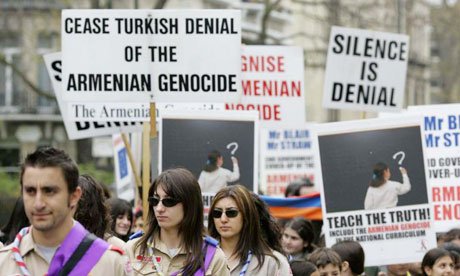
Members of the Armenian community join a demonstration march in London

Members of the Armenian community join a demonstration march in London in 2005. Photograph: Edmond Terakopian/PA

Turkey risks a collapse of its secular political system akin to that of the Soviet Union if it bows to international pressure to recognise the 1915-22 Armenian genocide, the head of Armenia's state memorial to the event has told the Guardian.

Hayk Demoyan said Ankara could not acknowledge the systematic killing of up to 1.5 million Armenians by Ottoman troops during the first world war because it would lead to a wholesale re-writing of history and undermine the ideological basis of the Turkish state.

In remarks that will cast a shadow over attempts to forge a new Turkish-Armenian rapprochement, he said those implicated included Mustafa Kemal Atatürk, founder of modern Turkey and a figure Turks are taught to revere. Historical documents proved Atatürk committed "war crimes" against Armenians and other groups in his drive to create an ethnically homogeneous Turkish state, Demoyan insisted. "Fear of rewriting history is the main fear of modern Turkey," said Demoyan, director of The Armenian Genocide Museum-Institute in Yerevan, Armenia's capital.

"It is a fear of facing historical reality and causing a total collapse of the ideological axis that modern republican Turkey was formed around. Turks get panicked when you compare Atatürk's legacy to Lenin.

Atatürk was sentenced to death in absentia by a military judge to punish war crimes during the first world war. There are documents from non-Armenian sources listing him as a war criminal ."

Demoyan's remarks come amid fledgling attempts to re-establish links between two countries which have not had diplomatic relations since 1994, following a war between Armenia and Azerbaijan, Turkey's ally.

Tentative efforts towards normalising ties occurred this month when the Turkish president, Abdullah Gül, visited Yerevan to attend a World Cup football match between Turkey and Armenia at the invitation of his Armenian counterpart, Serge Sarkisian.

Unlike most visiting heads of state, Gül did not visit the genocide museum, which displays documentary and photographic exhibits proving, Armenian officials say, that their ethnic brethren were subjected to deliberate genocide. Turkey vehemently denies this and has jailed Turkish citizens who argued otherwise. However, rising numbers of Turkish tourists and journalists have visited the museum recently.

"More than 500 Turks have visited this year. They've come in unprecedented numbers," Demoyan said. "Their reaction is one of shock. At first there is denial. Sometimes they ask: 'What is our sin?' or 'How can we be responsible for this?'. It's not taught in Turkish schools, so we understand their reaction."

Turkey claims the Armenian death toll has been exaggerated and that most victims died from starvation or disease. It also argues that many Turks were killed by Armenian groups.

Thursday, October 09, 2008

126 Holocaust Scholars Affirm The Incontestable Fact Of The Armenian Genocide And Urge Western Democracies To Officially Recognise It As Such

Statement by 126 Holocaust Scholars, Holders of Academic Chairs, and Directors of Holocaust Research and Studies Centers – March 7th, 2000


At the Thirtieth Anniversary of the Scholar’s Conference on the Holocaust and the Churches Convening at St. Joseph University, Philadelphia, Pennsylvania, March 3-7, 2000, one hundred and twenty-six Holocaust Scholars, holders of Academic Chairs and Directors of Holocaust Research and Studies Centers, participants of the Conference, signed a statement affirming that the World War I Armenian Genocide is an incontestable historical fact and accordingly urge the governments of Western democracies to likewise recognize it as such.


The petitioners, among whom is Nobel Laureate for Peace Elie Wiesel, who was the keynote speaker at the conference, also asked the Western Democracies to urge the Government and Parliament of Turkey to finally come to terms with a dark chapter of Ottoman-Turkish history and to recognize the Armenian Genocide. This would provide an invaluable impetus to the process of the democratization of Turkey.

Below is a partial list of the signatories:

Prof. Yehuda Bauer – Distinguished Professor, Hebrew University; Director, The International Institute of Holocaust Research,Yad Vashem, Jerusalem

Prof. Israel Charny, Director – Institute of the Holocaust and Genocide, Jerusalem; Professor at the Hebrew University; Editor-in-Chief of The

Encyclopedia of Genocide

Prof. Ward Churchill – Ethnic Studies, The University of Colorado, Boulder

Prof. Stephen Feinstein – Director, Center for Holocaust and Genocide Studies, University of Minnesota

Prof. Saul Friedman – Director, Holocaust and Jewish Studies, Youngston State University, Ohio

Prof. Edward Gaffney – Valparaiso University Law School

Prof. Zev Garber – Los Angeles Valley College

Prof. Dorota Glowacka – University of King’s College, Halifax, Nova Scotia

Dr. Irving Greenberg, – President, Jewish Life Network

Prof. Herbert Hirsch – Virginia Commonwealth University

Prof. Irving L. Horowitz – Hannah Arendt Distinguished Professor, Rutgers University, NJ

Rabbi Dr. Steve Jacobs – Temple Sinai Shalom, Huntsville, Alabama; Associate Editor of The Encyclopedia of Genocide

Prof. Steven Katz – Distinguish Professor, Director, Center for Judaic Studies, Boston University

Prof. Richard Libowitz – Temple University

Dr. Elizabeth Maxwell – Executive Director of the International Scholarly, Conference on the Holocaust, London, England

Prof. Erik Markusen – Southwest State University, MN

Prof. Saul Mendlowitz – Dag Hammerskjold Distinguished Professor of International Law, Rutgers University

Prof. Jack Needle – Director, Center for Holocaust Studies, Brookdale Community College, Lincroft, NJ

Dr. Philip Rosen – Director, Holocaust Education Center of the Delaware Valley

Prof. Alan S, Rosenbaum – Dept. of Philosophy, Cleveland State University

William L. Shulman – President, Association of Holocaust Organizations City University of New York

Prof. Samuel Totten – The University of Arkansas; Assoc. Editor of The Encyclopedia of Genocide

Prof. Elie Wiesel – Andrew W. Mellon Professor in the Humanities, Boston University; Founding Chairman of the United States Holocaust Memorial

Council; Nobel Laureate for Peace

I hereby declare that the originals of these one hundred and twenty-six signatories are on file in my office. All affiliations supplied are for identification purposes only.

Dr. Stephen Feinstein,

Director, Center for Holocaust and Genocide Studies, University of Minnesota

Monday, July 14, 2008

A landmark Armenian-Kurdish Conference held in the UK parliament.

PRESS RELEASE
Armenian Solidarity with the Victims of all Genocides
Centre of Halabja against the Anfalization and Genocide of Kurdish People
Seyfo Centre
c/o The Temple of Peace, Cardiff, Wales 07718982732

A landmark Armenian-Kurdish Conference held in the UK parliament.
Establishment of a permanent Kurdish-Armenian dialogue

This week marked a development in Armeno-Kurdish relations with a major
Conference held in the UK parliament. Nearly all of the UK Kurdish
organisations were represented.
On tuesday, in the House of Commons, Prof Kamal Mazhar Ahmad, former
Professor of history at Baghdad University gave a presentatiion based on
his book on the Kurds in World War 1 and the Armenian Genocide. He had
quoted from witnessess such as Faez Al-Ghosain who was in Turkey at the
time of the Genocide. He maintained that the killings were premeditated
by the Turkish state, rather than being outbursts of violence at local
level. His presentation (delivered in Arabic and translated) was well
received and several Kurds in the audience rose at the end to say that
Kurds should apologise for the involvement of many of them in the
Genocide. Several expressed their desire to become involved in the work
for Recognition of this Genocide .
It was decided unanimously, at the suggestion of Adnan Kochar,
director of CHAK, that we should write to the KRG government to ask for
official recognition of the 1915 Genocide of the Armenians and the
Assyrians, and also to the Armenian Government to ask for official
recognition of the Anfal Genocide
The other speaker, eminent Kurdish writer Rebwar Fatah concentrated
on issues of Human Rights related to Genocide.

On wednesday in the House of Lords, the issue of the betrayal of
Armenians, Kurds and Assyrians by the Great Powers in the Treaty of
Lausanne was addressed (close to its 85th anniversary). The speakers
were researcher Tony Kahve, writer Dr Kemal Miredali and researcher Ms
Soma Mallzada. The legitimacy of the Lausanne Treaty was challanged and
questioned from the perspective of the three nations which were not
allowed to participate in its creation.It was noted that Turkey has
continually broken the terms of the treaty, rendering it even more
invalid. The speeches will be ready for distribution soon.
One valuable contribution was sent to the Conference by Haydar Issik
a Kurdish writer now in Germany. (below)

THE ARMENIAN GENOCIDE AND

CURRENT DEVELOPMENTS IN TURKEY

BY HAYDAR ISIK (trans. Tony Kahve)

Ladies and Gentlemen,

I greet you sincerely and would like to begin by an extract from
David Kherdian's book called "In the Shadow of the Crescent." It was
published in Germany by the Peri publishing house. It reads as follows:

"Even if we are divided by force, we still remain one family. If one of
us dies, undoubtedly something dies in all of us. But if only one of us
survives then we will all live through that survivor. No happiness
emanates from disaster. What the Turk does is insanity. You may get
serenity one day followed by disaster the next.

We must wait and see as to which gate God will reveal to us.

I hope that the avenue which is about to open in front of us will also
bring us back. Whatever happens you must return."

These are the words of a grandmother of a large and prosperous
Armenian family in the Anatolian town of Afyon, before she was deported
to the Syrian desert.

Firstly, the young men were conscripted into the army, shortly after the
deportations begun.

At this point, I would like to note that the only survivor of the
family in the desert town of Deir Zor was a child called Veron. Indeed,
under these circumstances, even if he could return to Afyon, there was
no longer any one there to greet him. The land of Anatolia and the
Syrian deserts became the grave of 1.5 million Armenians. Incredibly,
even their graves could not be in their motherland. Their remains merely
gained the attention of scavenging animals. This is the greatest
humanitarian crime committed against the Armenian nation during the
first quarter of the twentieth century. It is a Genocide. Consequently,
the mass barbarism must be seriously questioned. The responsible element
must face its history. Bypassing the issue is sanctioning Genocide, thus
opening the gates of new Genocides. Claiming that we committed no such
crime and that they committed such crimes against us does not hide the
reality.

Anatolia's ancient people have felt the death of 1.5 million
Armenians, thus something has also died within those Turks and Kurds who
consider themselves human beings. Anatolia was a land populated with
Armenians at every sunrise, with them it was a beautiful land. Where are
our Armenian neighbours today? Why can't these ancient people of
Anatolia return to their country? Why shouldn't the present day sunrise
greet them as it used to? Previously, despite religious differences, the
Turk, the Armenian, the Assyrian and the Syrian as well as the Kurd were
one family. The Armenian man was enriching Anatolia with art and
culture. You have to think for a moment that if this Genocide had not
taken place couldn't all Anatolians still pursue a prosperous life
jointly? Doesn't the answer to this question reflect the words of the
old women that: "What the Turk does is insanity"? Indeed if this
insanity had not been committed the peoples of Anatolia today would
still have coexisted prosperously.

The Armenian people were the true owners of certain regions of
Anatolia and were the true wealth of those regions. What did the
destroyers of this wealth truly gain in their single-minded disease
incorporating a frenzy of Pan Islam and racist Pan-Turkism? The reality
is that now they are unable to wipe away the Armenian blood which stains
their foreheads permanently. Now, which ever door Turkey knocks on there
appears the Armenian Genocide.

The Kurds also became the triggers and revolvers of this genocide. I
never forget the statement made in 1956 by a Muslim called Sofu Hasan
from the town of Mush. "We were told that the Armenians were to attack
the mosque. We, however, acted rapidly and quickly gathered them. I know
that I killed five Armenians with one bullet".

Sofu Hasan believed he was conducting the orders of former Caliphs.
He would pray profoundly for the day when he would be received by God.
The important point to comprehend here is that the spirit of Sofu Hasan
has now entered the AKP the ruling party in Turkey. AKP believes that it
has inherited the Ottoman past, and does not recognise the Genocide,
this means that it is sanctioning it.

During the late nineteenth century, 36 Kurdish clans were organised
into special brigades by Sultan Abdul Hamid in order to eliminate the
Armenians. Thus the Kurds became the instruments of that government.
Today, however, 75 members of the Grand National/Assembly fortified with
a number of ministers have become the triggers against the Kurds. The
Kurdish brigades of the past are the shame of the Kurdish people.

One Armenian survivor of the Genocide describes his experience as
such: "Our deportation column gradually got smaller, partly because
numerous children were killed or kidnapped. One night we were
approaching a caravanserai, fifteen of the surviving children rushed to
a well next to the buildings in order to drink water. The officer in
charge believed that their true intention was to escape. Consequently,
two gendarmes were sent after them. They were promptly put in a line and
shot. They were between 8 and 12 years old.(Erlebnisse, Therese Lehmann
Haupt p8 Donat & Temman Veslag)

Unfortunately, the nature of these events is most heart breaking.
Sadly, even today we live in a state that the Turkish police, in front
of the TV cameras, will break the arm of a child and viciously beat
women and children. The Turkish soldier will happily decimate the bodies
of the guerrillas he has killed. Such violence demonstrates once again
the murderous continuity emanating from the Committee of Union and
Progress and its extension the Kemalist regime.

This ideology [based on Turkism] incorporates cultural elimination,
thus Armenians are unable to survive in Anatolia. Murder of Hrant Dink
was also committed by the same insane psyche. The same insanity is now
attempting to eliminate the Kurds. AKP and its generals have spread
their war throughout Kurdistan. The Turkish regime is racist and
ideologically lives in the past. Turkey must apologise to the Armenians
and promote the principles of peace and equality with the Kurds;
otherwise it cannot survive by a policy of permanent murder. Turkish
politicians should get on their knees at the Genocide Monument in
Yerevan and ask for forgiveness. Just as Willy Brandt did in Warsaw for
the Second World War crimes.

What has happened to the Armenians should never be forgotten.
Anatolian people must be told the truth. Personally I have been
threatened numerous times due to the articles I have written about the
Armenians. But as a human being it is my duty to acknowledge the
Armenian Genocide. At every opportunity, I present articles and continue
to make speeches. Thus, I convey my support to the Armenian people and
wish them all the success